
The Exit Interview: What Real Estate Agents Are Asking Before They Leave Their CRM
For years, most real estate CRM conversations focused on organization. Agents wanted a platform that could keep contacts in one place, automate reminders, track conversations, and integrate with the rest of their technology stack. As long as the system helped manage leads more efficiently, it was considered successful.
More agents are now reevaluating their CRM through a very different lens, asking questions that go beyond usability or interface design. Before committing to a platform long term, many teams are essentially conducting an “exit interview” with their current CRM and asking whether it is actually helping them grow or simply helping them manage complexity more efficiently.
Those questions have become more urgent as real estate businesses rely on larger databases, more automation, and have increasingly fragmented technology stacks. Many agents are running one system for lead generation, another for websites, another for dialing, another for transaction management, and another for marketing automation. While that approach may have worked when CRMs were primarily organizational tools, the cracks in disconnected systems become more visible as businesses scale. For many agents, that's the moment the exit interview becomes unavoidable.
It's exactly that friction that eventually lands agents in the exit interview — asking not just whether their CRM works, but whether it's actually moving the business forward. And increasingly, the answer to that question comes down to whether a platform can actively help convert opportunities, automate engagement intelligently, and support the entire customer journey inside one connected ecosystem.
AI is accelerating that shift even further. Traditional AI tools have largely focused on assisting with individual tasks such as writing emails, generating marketing content, or automating scheduled communication. While those capabilities are valuable, they still require agents to manually guide much of the process. As consumer expectations rise, agents are increasingly looking for systems that can proactively help identify opportunities, maintain engagement, and reduce the operational gaps that often slow down conversion.
This is where agentic AI is becoming an important differentiator in the CRM conversation. Instead of waiting for an agent to manually trigger every workflow, agentic AI is designed to monitor activity, recognize behavioral patterns, and respond dynamically based on consumer engagement. That creates a meaningful operational shift because the CRM is no longer functioning solely as a database or task manager. It becomes an active participant in lead conversion and relationship management.
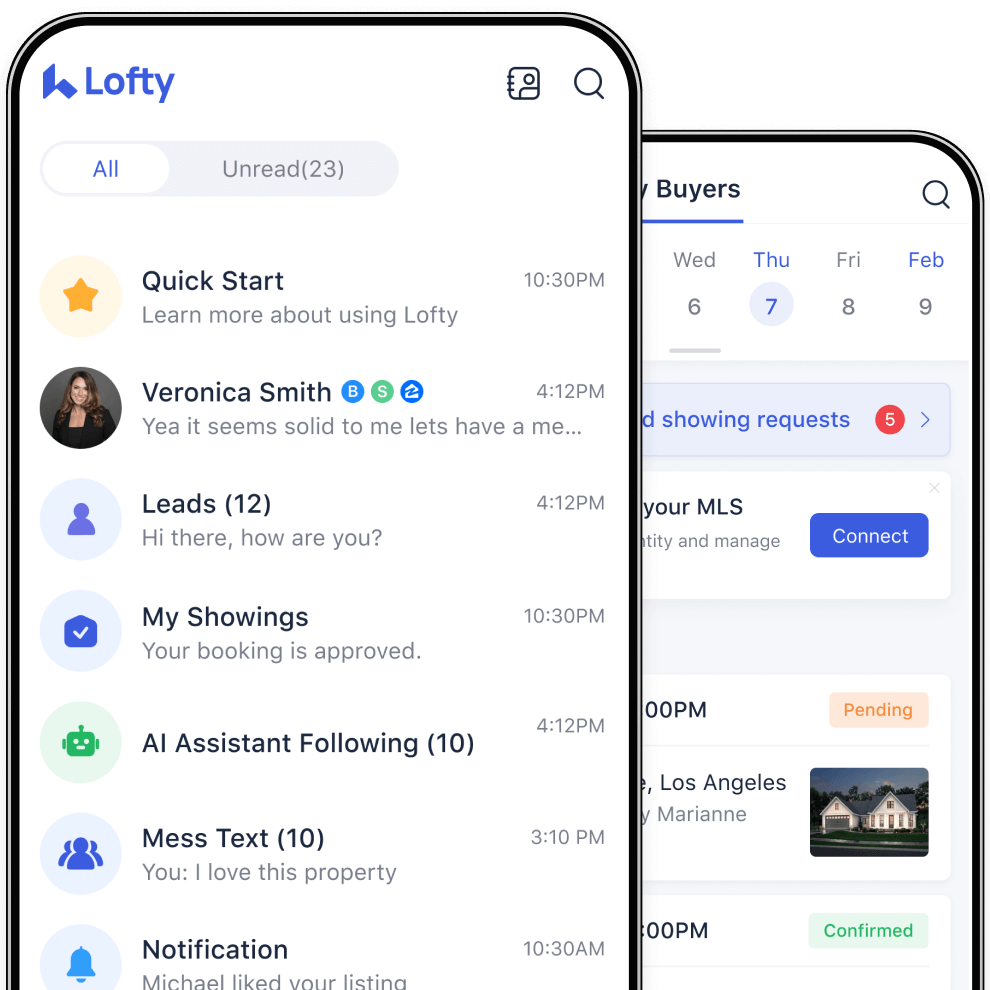
Lofty’s AOS platform was built around this behavioral approach. Rather than relying on disconnected tools or passive CRM automation, the platform combines AI-powered engagement, CRM intelligence, websites, marketing automation, lead routing, and transaction workflows into one connected ecosystem. Multiple AI-driven systems work together to engage leads through text and email conversations, respond to inquiries in real time, identify behavioral signals, qualify prospects, and help move opportunities toward appointments while agents focus on active clients and negotiations. By continuously monitoring engagement activity such as website behavior, saved listings, repeated searches, and communication patterns, the platform helps surface intent as it develops and allows teams to respond more proactively throughout the customer journey.
For many agents, this is exactly the type of functionality driving today’s CRM reevaluation process. The question is no longer just whether a platform can store contacts or automate a drip campaign. Agents increasingly want to know whether their CRM can help eliminate response gaps, centralize engagement, and create operational continuity across the entire business.
Additionally, integration has become far more important than feature quantity alone. Many platforms advertise similar tools, but when those tools operate independently, agents are left manually managing the handoffs between systems. Duplicate data entry, fragmented lead histories, delayed routing, and inconsistent reporting become operational burdens that compound over time. Lofty approaches the problem differently by operating as a connected platform rather than a collection of separate applications. The CRM, IDX websites, AI Sales Agent, Smart Plans, lead routing, marketing tools, communication systems, and transaction management tools all function inside the same ecosystem. That continuity allows behavioral data and lead activity to flow through the platform without requiring constant manual coordination between disconnected systems.
As more agents evaluate the future of their business, many are realizing their CRM needs to do more than organize information. It needs to actively support conversion, maintain engagement, and help teams operate more efficiently in an increasingly competitive environment. That realization is shaping the new “exit interview” happening across the industry, where agents are taking a harder look at whether their current CRM is truly built for the next phase of real estate growth or simply helping them maintain outdated workflows.